Horoscopes
 I'm abit stuck..... Have started the illustrations but I'm worried there going to take far too long. I could spend the next 2 months doing them and still not be happy. It seems its going to have to be quantity over quality. I am beginning to think that I might have to just concentrate on two of the chosen narratives. Thsi way I will be able to show how the piece will look without having to sacrifice design and style.
I want to include multiple illustrations in my peice but these all need researching as I'm looking at symbolism. The previous mentioned observations on sleeping beauty hold a lot of weight however there very difficult to "show". Have been looking at horoscopes and "The book of hours"- a book designed to help its owner with pious devotions at different times of day. The introduction was always a calender, usually illustrated to show activities appropriate for each month.
Came across a Victorian board game book in Clifton's Oxfam the other day. It was interesting to look at the narratives and how the player navigated themselves around the board. Found this interesting blog on board games. One could say that interactive narratives a different type of board game- your trying to get from A to B (usually), there's a narrative (usually), if you miss something you have to go back (usually). Haven't really thought this through but I think its something to look into.
 First Plan:
You travel from left to right. The actual navigation design will look very different but so I know the exact plan. As you can see there are problems in the Grimm version. I did anticipate this. I think I will just have images in the two vacant pages, however the rest of the stories aren’t going to fit with the ending of Grimms. Not sure what to do about this yet? It too late to start trying to find another version, as well I think it is important to have a Grimm version within the piece...
- Max Luthi
Have finally started the illustrations and so have been looking at symbolism, like I have mentioned previously I would like to include some of this using imagery and text (hidden within the images). This link I have included is especially good as it looks at all the versions that I have decided to use. Obviously you cannot take every thought as gospel and some of the ideas seem quite extreme- I have been trying to find text that was written by the authors on there tales but this seems to be impossible. I think I will take some ideas that I like and disregard others.
Observations On Grimm:
Since the curse is one of the dominant features of the tale, it is reasonable that many psycho-analytical symbolisms have been drawn from it. The most reasonable of these metaphors is that the curse represent new restrictions imposed on a female at puberty. Thirteen, the age of Brier Rose in some of the versions, was traditionally the age when menstruation started, so it can be seen as the beginning of womanhood. This line of thought leads to another of the symbolisms. The underlying cause for the curse results from the realization that Brier Rose has the potential for becoming an object of desire. Her potential sexuality threatens men and makes women jealous. Because of jealousy, the old/evil fairy wishes to stop Brier Rose from ever taking her place as a woman and to die before she can experience the "joys of courting and marriage."
The curse itself has another intriguing symbolic meaning. It can be interpreted as the onset of menstruation. Bettelheim elaborates on this metaphor. The thirteen good fairies represent the thirteen months of the lunar calendar. The twelve that are good also represent the twelve months in the traditional calendar. The thirteenth fairy, since there is no thirteenth month in traditional calendars, represents menstruation. In addition, since the curse came from an old woman, there is the added significance of the "curse" being passed from woman to woman and originating with the oldest woman, Eve.- This might be interesting to illustrate could have a calendar or a watch. The sun and Moon= Time passing. Could have the light changing through certain pages, symbolizing time passing.
Another analysis suggested other motifs behind the Father's action. By banning spindles, he can prevent Brier Rose from ever having to engage in onerous tasks not "befitting a princess." (McGlathery, p 98) The King also takes away Brier Rose's chance to dream, since spinning is associated with dreams- This is interesting as it was an observation I made myself. Like I have mentioned I wondered at the choice of "evil object"not just in Grimms but in all versions.
Spinning has several general symbolisms. Spinning, and especially the spindle itself, is associated with dreams of "building romantic castles in the air," (McGlathery, p 98) which in Brier Rose's case are taken away by the King's ban on spindles. It is also seen as a passage to sexual adulthood. The spindle, according to Bruno Jockel, can also be a male symbol directly implying sex. Appearing to following the same line of thought, Bettelheim interprets the distaff, the part of the spindle which rotates and collects the thread, as a penis. Weaving and spinning are also commonly associated with women
Bettelheim, in one of his non-sexual interpretations, also focuses on the absence of Brier Rose's parents when she pricks her finger. He claims this represents the parents inability to help children through the various trials of growing-up.
The interpretation of Brier Rose's long sleep has progressed along two lines. The first is sexual, like most psychoanalytical interpretations of this fairy tale, and comes from Bettelheim. Its reasoning is based on the assumption that the sleep is symbolic of the wait for sexual fulfillment. It comes at the end of childhood and is a way to prepare Brier Rose for a later "sexual union." (Bettelheim, p 232) She spends these years withdrawn and in inner reflection. The sleep may delay her eventual sexual maturity, but in the end, it will happen and with as much glory as ever.
Bettelheim also asserts that this long sleep is the only way to avoid change and development. McGlathery adds that it allows Brier Rose to remain a maiden for a hundred years. She is also reduced to passivity since she can not actively persue a prince while she is sleeping. Bettelheim does add that this shutting out of the world is unhealthy and that it must be broken by the transformation of the girl into the woman.- Have been wondering how I can show the princess sleeping, she must have dreamt- and I would like to include imagery of her dreams.
Several interpretations see the Prince as a father substitute since in many versions the Prince arrives in the story only after the Father leaves it. McGlathery goes on to say that the Prince's actions are what the Father would like to do, but is prevent from by incest taboos.
The Prince's arrival at the appropriate moment marks Brier Rose's sexual awakening and/or the birth of the higher ego, according to Bettelheim. The Prince also makes a "more appropriate object of curiosity and desire" (McGlathery, p 118) than the spinning wheel which is what fascinated Brier Rose when she fell asleep. Bettelheim sees two significances in the transformation. The first is that Brier Rose is finally ready for a sexual encounter. The other, which is actually not sexual, is a general life lesson. Do not worry about a seemingly "impossible problem." (Bettelheim, p 233) When the time is right, it will solve itself.

 Arthur Conon Doyle not only accepted these photos as genuine, he even wrote two pamphlets and a book attesting the genuineness of these photos, and including much additional fairy lore. His book, The Coming of the Fairies, and some people still believe the photos are authentic. Doyle's books make very interesting reading even today. Doyle's belief in spiritualism, convinced many people that the creator of Sherlock Holmes was not as bright as his fictional creation.
Some thought Conan Doyle crazy, but he defended the reality of fairies with all the evidence he could find. He counters the arguments of the disbelievers eloquently and at great length. Over the years the mystery persisted. Only a few die-hards believed the photos were of real fairies, but the mystery of the details of how (and why) they were made continued to fascinate serious students of hoaxes, frauds and deceptions. When the girls (as adults) were interviewed, their responses were evasive. In a BBC broadcast interview in 1975 Elsie said: "I've told you that they're photographs of figments of our imagination and that's what I'm sticking to."
I am finally going to start the final images on Thursday which I am rather looking forward to. Have been continuing with my research in all areas especially on design and flash design. Would love to make this project animated or at least include some movement however I worry that this again is slightly ambitious. Good use of motion graphics- Hillmancurtis webdesigners
Narrative:~
Have been going through in my head how it is going to work and one problem that has presented itself is the text. Some of the narratives there is nearly two pages of text on others there is only a short paragraph. This presents problems for the design- So I've come up with an idea of having changing text- you read a bit and then more text appears. I would like to have changing illustrations with the text but as the brain cannot process images and read text this seems slightly pointless. Have been reading James Elkins book "Why are out pictures puzzles? On the modern origins of pictorial complexity" To give myself a base in which to use image, illustration, design to represent thoughts and ideas- as well it has been useful in understanding certain aspects of fairytales. Fairytales often use everyday objects and then good or evil is projected onto them ie The needle, the glass slipper, a basket, a sword, a mirror (Narcisstic reflections on self reflection??!!) The list is endless. I want to know why a piece of flex or in the changed versions a spinning needle was used as the object to cause harm. There must be some reason for this??? These are all types of things that I want to include in the graphics. I hope that each page, as well as the original narrative that goes with it, will have at least four other parts of text explaining things etc. But I need to find what to explain first!
Navigation:~
Again more problems with this aspect of the project. Although I have the basic outline of the structure I'm still not convinced that its going to be obvious and that people will understand what they are doing. Have been thinking of having a short animation detailing the rules, so to speak, showing examples of the paths you can take etc. But again not convinced by this. Its seems like that is giving the reader too many constraints- were going into authorship here will write more on this at a later date.
The words 'Fey' and 'faerie' come from the French and started to replace the old English 'elf' during the Tudor Period. Spencer and Shakespeare popularized the change. 'Elfland' and 'faerieland, 'Elf' and 'Faerie' were and are still interchangeable words. The spellings of Faerie are numerous: fayerye, fairye, fayre, faerie, faery, fairy. Faerie refers to the world of faerie as an entity ( noun), as a geographical location, as a general name for its inhabitants (faerie, faeries) and as an adjective to describe its attributes. I've been researching all of this obviously due to the name given to my chosen study: fairy tales. I've been looking at dates and trying to figure out what Perrault was doing putting fairy's into his tales????? Faeries aren't nice creatures, they can have good attributes, but have never been trusted and surely would not have been given the role of godmothers. Given that, they do not have particularly magical powers and surely would not have been able to deliver the gifts that Perrault sets out in his version. The Blue fairy ( Sleeping Beauty is in the blue book) - " is favourably disposed towards humans, or, at least, towards humaniod toys who wish to become human. The wooden puppet Pinnochio sought her help to become a real boy. Similarily, the Mecca (mechanical lifeform) David sought out the Blue Fairy, who he thought could turn him into a real boy - a transformation which he believed would enable the human named Monica Swinton to love him as she loved her human son Martin. Tragically, the Mecca David failed in his quest to find the Blue Fairy as he was waylaid by a plaster cast made in her likeness which, unbeknownst to David, did not have the ability to help him which the real Blue Fairy would possess.". Have been re-reading Shakespeare and have enjoyed actually being able to understand some of the more obscure faerie references:
"Where the bee sucks there suck I,
In a cowslip's bell I lie"
ARIEL: The Tempest Act 5.
This gives reference to the faeries love of cowslips. There love is due to their power to find hidden faerie gold and are also known as 'Culvers Keys' (Keys to unlock the way to treasure) in the West of England. Again time is important here as well as different countries ideas and/or methodology's of faeries. Maybe in Italy faeries are nice creatures?? Will have to look into this. Its not really relevant but my interest in faeries has been re-awakened.
Here is a link to a site on Welsh Faeries- my interest is in the Green Lady of Caerphilly, she takes on the appearance of Ivy and I've always found this tale interesting.
I have been reading or trying to "The coming of the fairies" by Arther Conan Doyle.
"A book is more than a verbal structure or series of verbal structures; it is the dialogue it establishes with its reader and the intonation it imposes upon his voice and the changing and durable images it leaves in his memory. A book is not an isolated being: it is a relationship, an axis of innumerable relationships." Borges -- Essay: "A Note on (toward) Bernard Shaw"
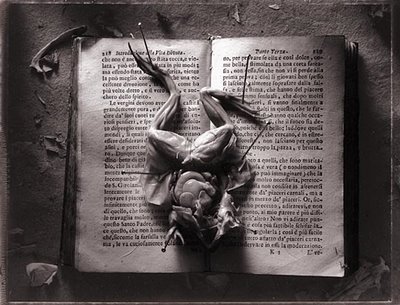
Secret Images:- Unpublished Borgesian photos by Sean Kernan. Really beautiful imagery. Have been researching styles in particular using photographs. Need to cut down the amount of time I'm spending in illustrator and photoshop so thought as well as including illustration I will also use photos. Want to create a really colorful mix of imagery taken from a range of disciplines. I like his use of books. The idea of showing imagery of books on a computer screen particually in the context of a hypertext novel makes me feel somewhat sad, maybe sad is the wrong word, uneasy? No thats a even worse word, unsettled.
An idea intitally put to one side, has come back around and made itself relevant. One of my first ideas was to use the devised structure of a fairytale by Vladimir Propp, to use as my own structure for the narrative. I put this idea to one side thinking it was to complicated and due to the fact that most of Propps theories seem to not work in the real world, or at the very least seem to have small flaws within them, that make the whole idea unusable. But recently I seemed to have got drawn back to them.
Vladimir Propps observations on Fairytales:
| 1. | Functions of characters serve as stable, constant elements in a tale, independently of how and by whom they are fulfilled. They constitute the fundamental components of a tale. |
| 2. | The numbers of functions to the fairy tale is limited. Freedom with this sequence is restricted by very narrow limits which can be exactly formulated. |
| 3. | The sequences of functions is always identical. Since we are studying tales according to the functions of their dramatis personae, the accumulation of material can be suspended as soon as it becomes apparent that the new tales considered present no new functions. |
| 4. | All fairy tales are one type in regard to their structures. |
Thought I should recap on whats been happening so far. Have just been reading through this blog and I don't think its very clear...
So the general idea: An interactive narrative based on the fairytale Sleeping Beauty, combining multiple versions, which the viewer has control over. So for example someone might be happily going through Perraults versions and then decide that they want something a bit more gritty and swop to Basiles version, and then if they want a happy ending, end on Grimms. I think of it kind of like an editors version of a fairy tale. You edit the narrative yourself. I think that's clear??? What I would like to include is where characters have migrated within the original texts, you as the viewer could move fairy tale with your chosen character. ( Example: The wicked Stepmother originally started off as a wicked wife (Basile) in that the prince was already married, but it was decided to shorten Sleeping Beauty so the ending was when she woke up, so the wicked Stepmother was no longer needed, it was decided to plonk her into Cinderella) However I think that might be making the project slightly ambitious for the time allowed as well as making everything else ie programming, design, navigation eight times harder then its already going to be.
Navigation: Have finally come up with a navigational structure that I'm happy with. Have settled on a grid of circles. You travel from left to right choosing your circle. Will post some diagrams of the new structure with notes on how it is going to work. Have figured out how to program it all in Flash, the navigation will be the main page, depending on what circle you press that will load in the background image. I want to use Photoshop and Illustrator for the designs instead of my proposed use of the Flash drawing tools. This has meant I've had to re-think the structure of the piece. People won't wait for something to load, it needs to be quick and seamless. Hopefully my new idea will enable this.
Design: Have come up with a design that I'm happy with. I am going to keep the same style, however use different colours to indicate which authors version you are on. Like I previously mentioned the navigation system will be on the page at all times, with the text and images fitted in around the outside. The navigation system will always be on a layer above the main image, so the background behind the navigation system will change also. To make this project relevant not just for this module but also my own development using Flash I would like to include a zoom in/out function as well as the ability to "drag" yourself around the screen. In this I mean you will be able to move around the screen yourself. This will be needed for some aspects of the design. I would like to include quotes as well as meanings that are not relevant to the narrative, but should the viewer wish to learn more about the background of the narrative strand they are on, they can. This will mean the viewer will have to zoom in and out and really hunt for the text. Should they not want to, they can take the page at face value and continue onto the next chosen narrative section.
Create a set of five criteria which you feel could be used to describe the nature of your practice.
(Not sure if I've done these right. But these are the things that I feel are my interests and therefore my criteria.)
Narrative- Interactive Media
The Internet and the possibilities of narrative
Artists/Illustrators/Graphics
Designing interactive pieces.
Using your set of criteria, research a long list of at least 20 practitioners whose work meets at least three of your five criteria.
Have included links for web pages. These might not necessarily be the best links for them in general, but they have been useful to me. They are in no order simply as my mind remembered them. For a more indepth look at these practioners read the rest of my blog, where most have been mentioned.
Ernest Adams:His work includes original design, game analysis, creative writing. Am interested in him because of his interactive writing.
Scott Mcloud: theorist/comic writer who has written comics on how to make comics. Also examines interactive comics and the approaches needed.
Paula Rego: Artist who explores narrative through her paintings.
Janet Murrey: Theorist, among other topics, looks at narrative and the internet in general. She is also an interactive designer.
Neil Gaimon: Writer. Writes novels and comics. Good to look at as his graphic novels which are obviously illustrated. Makes me see who narrative can be made into images.
Madeleine De Scuderie: 16th Century Writer. Explored interactive narrative for books
Hester Pulter: Another 16th Century Writer.Like Madeleine wrote interactive novels in book form.
Lev Manovich: Theorist among other things. Looks at narrative and the internet in general.
Kiki Smith: Artist who again explores narrative with painting.
Mark Stephan Meadows: A theorist, and interactive artist. Good to look at as he implements his theories into his work.
Ed Ruscha: Artist. My particular interest in him, is his graphic prints of words. He takes a word any word and trys to illustrate it and show meaning, just using the typography
Edward Gorey: Illustrator, writer, again meaning through image.
Vladimir Propp: extended the Russian Formalist approach to narratology (the study of narrative structure). Where, in the Formalist approach, sentence structures had been broken down into analyzable elements - morphemes - Propp used this method by analogy to analyze folk tales.
Borges: Writer. Interesting narratives as well as descriptive writing. (Creatures etc)
Virginia Woolf: Writer. Her novels like to explore memory and uses different linear approaches. Not my favorite author but good for her use of narrative structure.
Doris Lessing: Writer. Like Virginia she explores narrative structures in her novels.
Dave Mckeen: Illustrator, Designer. I find his work very descriptive even without the text that comes with his work. My favorite illustrator.
Brian Froud: Illustrator. Good to look at for mystically and fantasy art work. Another of my favorite illustrators
Terri Windling: Artist. Again explores fantasy and myth
Marina Warner: Writer and theorist (Feminist) Has studied the fairy tale.
Ted Nelson:Theorist.
Alan Key: Theorist.
Having selected the longlist, make a shortlist of five whose work closely reflects the spirit of the criteria you identified.
This is really tricky. I would not say that there are five people that fit my criteria. Mainly because my criterias are very different to each other. These are simply people that inspire me, or help to inspire me. Again in no order:
Dave Mckeen
Brian Froud
Scott Mcloud
Vladimir Propp
Mark Stephan Meadows
Have been reading through the requirements of a "journal" and I don't think I have been very good at organizing my thought patterns. Now unfortunately my thought patterns aren't terribly organized ether, things come to me and random times of the day, at random places not necessarily in the order in which a project will/should/does develop. For example I already know how I am going to structure the actually Flash document in that I plan to load in the different elements of the page, thus keeping down download time, as well as that I plan to transfer the template into a blog-mainly because I cannot afford more web space and secondly because I want to try to make blogger work in this way. It will allow viewers to leave comments and maybe information that they know about that I have not included. (Although it might not let me and this therefore will have to be changed). Now I've written this down I really don't think that it will work. Unless its specifically set up right- which is against bloggers rules. But that is another post surely!
They want us to personally record our journey through our research and project, including all the hurdles and negative thoughts.... I have a lot of negative thoughts in general never mind on work that I'm doing but I will try to express them as I go along from now on.
more on this later....
Links for XML and databases:
www.3schools.com
www.oreilly.com
www.macromedia.com: Look at Flash/Data Intergration: Bike Trips Sample is a good one!
XML: Displaying XML Data in Web pages.
I am trying to be really good and write/link all the websites that I have been looking at for this project. However I keep forgetting, and then I lose that post it note that was stuck on the back of the toilet door (For some unknown reason) and then its lost forever.... Never destined to be used in the bibliography. So here is some more (There all very obvious links but you have to start somewhere):
